Original: $37.50
-65%$37.50
$13.12The Story
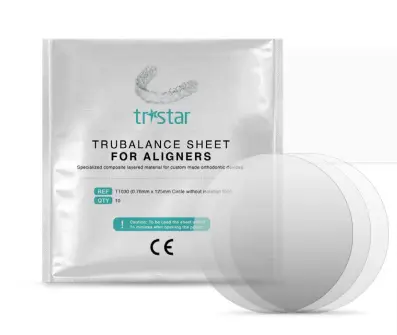
| 0.76mm*125mm - 10 sheets/pack |
Most of the other commercially available materials are made of polyester material using only PETG as its base resin. Tristar is made using rigid engineering resin at the composite core with superior stress retention and cracks resistant properties.
In addition to being tough and durable, this material performs exceptionally well in aligning patients’ teeth. Its other significant benefits include superior chemical stain resistance and clarity.
CRACK RESISTANCE
Cracking can occur when removing an appliance from a forming mold, or by a patient when in use. Tristar having a tough polymer backbone, has a reputation as the benchmark for crack resistance. Plastic toughness and crack resistance can be evaluated by measuring Impact Strength.
Please see a video comparison of the material here:
Over a decade of experience in fabricating clear aligners has demonstrated that demands for clear
aligner movement has increased, from simple first order alignment to complex torque movements as well
as vertical control.
KEY FEATURES: STRESS RETENTION
The impact strength was measured according to Standard Test Method (ASTM D5420) for Impact Resistance of Flat, Rigid Plastic Specimen
Original clear aligners were single layered materials or simple dual layered materials. These were often either of polyurethane, a flexible or tough material, or based on Polyethylene terephthalate glycol, commonly
known as PETG.
These original formulations had various compromises. Polyurethane, although tough, often proved to be too stiff. PETG, although aesthetic, had fairly poor crack resistance and often users would complain of aligner breakage upon insertion or removal.
By far the biggest compromise was the fact that all single layer plastic materials exhibit fluid properties. A portion of the plastic sheet behaved like an elastic, rebounding back to its original form, but a large percentage of the plastic sheet behaved like a fluid, causing permanent deformation and lack of force consistency. Current single layered materials lose up to 50% of their ability to deliver the same force over the first 8 hours of application of the aligner.
Description
| 0.76mm*125mm - 10 sheets/pack |
Most of the other commercially available materials are made of polyester material using only PETG as its base resin. Tristar is made using rigid engineering resin at the composite core with superior stress retention and cracks resistant properties.
In addition to being tough and durable, this material performs exceptionally well in aligning patients’ teeth. Its other significant benefits include superior chemical stain resistance and clarity.
CRACK RESISTANCE
Cracking can occur when removing an appliance from a forming mold, or by a patient when in use. Tristar having a tough polymer backbone, has a reputation as the benchmark for crack resistance. Plastic toughness and crack resistance can be evaluated by measuring Impact Strength.
Please see a video comparison of the material here:
Over a decade of experience in fabricating clear aligners has demonstrated that demands for clear
aligner movement has increased, from simple first order alignment to complex torque movements as well
as vertical control.
KEY FEATURES: STRESS RETENTION
The impact strength was measured according to Standard Test Method (ASTM D5420) for Impact Resistance of Flat, Rigid Plastic Specimen
Original clear aligners were single layered materials or simple dual layered materials. These were often either of polyurethane, a flexible or tough material, or based on Polyethylene terephthalate glycol, commonly
known as PETG.
These original formulations had various compromises. Polyurethane, although tough, often proved to be too stiff. PETG, although aesthetic, had fairly poor crack resistance and often users would complain of aligner breakage upon insertion or removal.
By far the biggest compromise was the fact that all single layer plastic materials exhibit fluid properties. A portion of the plastic sheet behaved like an elastic, rebounding back to its original form, but a large percentage of the plastic sheet behaved like a fluid, causing permanent deformation and lack of force consistency. Current single layered materials lose up to 50% of their ability to deliver the same force over the first 8 hours of application of the aligner.